


REPAIR ISDT FD-200 Discharger
REPAIR ISDT FD-200 Discharger
This FD200 discharger has
just
come back from repair and is fully functional!
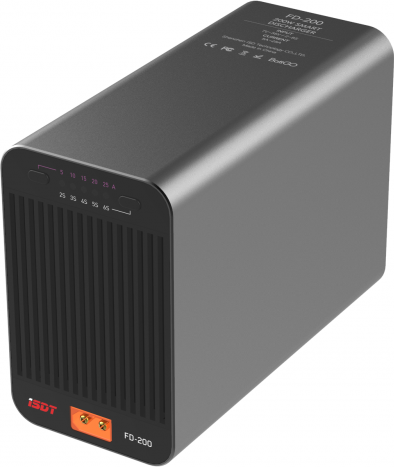
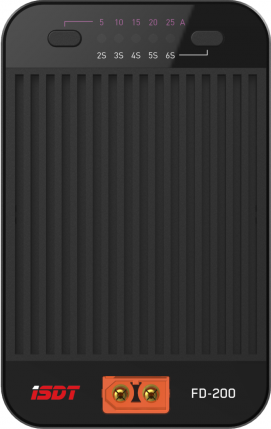
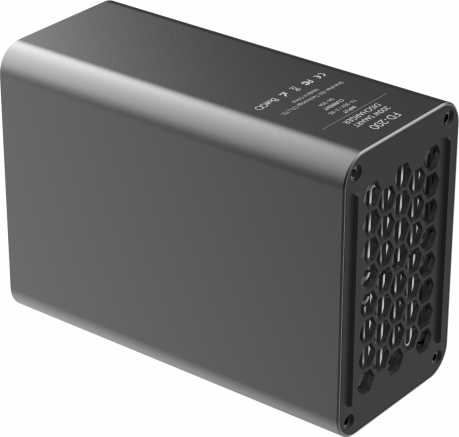
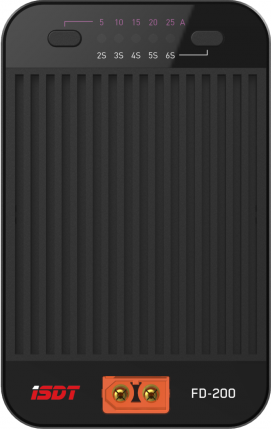
The iSDT FD-200 discharger offers up to 200W of discharge power, making it suitable even for larger battery packs, ensuring they are discharged within a reasonable time. It can discharge 2–8S LiXx batteries, and the discharge current can be easily adjusted on the unit from 5 to 25 amps. The discharge voltage is fixed at 3.8V, ensuring simple and safe operation. Via the Bluetooth function, everything can be monitored and adjusted on a smartphone using the iSDT app. With dimensions of 142 x 100 x 63 mm and a weight of 790 grams, the FD-200 is extremely handy. The fan speed is regulated, but may be clearly audible under heavy load.
Info : A connection cable between the battery and the discharger is NOT included. You will need a cable with an XT60 connector, which you then connect to your battery!
Technical specifications :
- Dimensions: 140×60×100mm
-
Weight: 790g
- Maximum discharge power: 200W
-
Input voltage: 7–35V
-
Discharge current: 5/10/15/20/25A
-
Number of cells: 2–8S
- Full automatic shut-off
- Alarm for unauthorised battery voltage
- Conversion efficiency: 93.2% at 220V and 65A
-
Error message when setting the cell count
-
System support: Android 5.0/iOS 10.3
- Bluetooth support
- Connector input: XT60
Why discharge batteries?
1. To improve cell balancing
Moderate discharging can help to equalise the voltage of the individual cells. This makes it easier for the charger to balance the cells (cell balancing) later on during charging, particularly for batteries where the cells tend to drift apart slightly.
2. Maximise capacity utilisation
Discharging to a defined, low voltage level (typically approx. 3.5–3.7V per cell) ensures that the battery absorbs as much of its full capacity as possible during the next charge. This is particularly useful if you want to achieve maximum voltage (‘Top Voltage’) and energy output in the next heat.
3. Optimise voltage peaks in the next heat
In certain classes (particularly in stock classes or with controlled engines), targeted discharging can make the battery feel slightly ‘fresher’ or ‘more aggressive’ during the next charge, as it delivers higher voltage peaks when fully charged (e.g. more punch during acceleration).
4. Temperature management
Controlled discharging also lowers the battery temperature for the subsequent charging cycle — this is important if the battery is still warm immediately after a run. LiPos do not like being stored or charged whilst hot.
Important: Risks & Limits
Never discharge below 3.0V per cell! Discharging any lower damages the chemistry and can cause permanent damage to the cells.
No ‘forced discharge’ is necessary after every run — only when specifically required by the set-up or racing strategy.
Keep discharge currents moderate — 1–5A is typical, depending on battery capacity.
LiPo storage mode ≠ race preparation — storage voltage (~3.8V/cell) is intended for storage, not directly for racing.
In short :
Targeted discharging before charging can help prepare the battery for maximum performance in the next race session (better balance, higher peak power). However, it should be used in a controlled and deliberate manner; otherwise, it risks doing more harm than good.
Ergänzende Informationen / Additional information
Verantwortlicher / Responsible
SieBra GmbH & Co. KG
Christian-Liebrecht-Straße 6, 58739 Wickede
DE
https://www.rc-dome.de/
info@rc-dome.de
Hersteller / Manufacturer
SHENZHEN ISD TECHNOLOGY CO., LTD. (ISDT
5th Floor, Yutian Building, No. 18 Yangtian RD, Xin'an Street, Bao'An District, Shenzhen, Guangdong, PR
CN
 |
ACHTUNG: Nicht für Kinder unter 36 Monaten geeignet wegen verschluckbarer Kleinteile, Erstickungsgefahr. CAUTION: Not suitable for children under 36 months due to small parts that can be swallowed, choking hazard. |
| ACHTUNG: Nicht für Kinder unter 14 Jahren geeignet. Benutzung unter unmittelbarer Aufsicht von Erwachsenen. CAUTION: Not suitable for children under 14 years of age. Use under the direct supervision of adults. |
| Electronics: | Entladegeräte |
|---|
REPAIR ISDT FD-200 Discharger
REPAIR ISDT FD-200 Discharger
This FD200 discharger has
just
come back from repair and is fully functional!
The iSDT FD-200 discharger offers up to 200W of discharge power, making it suitable even for larger battery packs, ensuring they are discharged within a reasonable time. It can discharge 2–8S LiXx batteries, and the discharge current can be easily adjusted on the unit from 5 to 25 amps. The discharge voltage is fixed at 3.8V, ensuring simple and safe operation. Via the Bluetooth function, everything can be monitored and adjusted on a smartphone using the iSDT app. With dimensions of 142 x 100 x 63 mm and a weight of 790 grams, the FD-200 is extremely handy. The fan speed is regulated, but may be clearly audible under heavy load.
Info : A connection cable between the battery and the discharger is NOT included. You will need a cable with an XT60 connector, which you then connect to your battery!
Technical specifications :
- Dimensions: 140×60×100mm
-
Weight: 790g
- Maximum discharge power: 200W
-
Input voltage: 7–35V
-
Discharge current: 5/10/15/20/25A
-
Number of cells: 2–8S
- Full automatic shut-off
- Alarm for unauthorised battery voltage
- Conversion efficiency: 93.2% at 220V and 65A
-
Error message when setting the cell count
-
System support: Android 5.0/iOS 10.3
- Bluetooth support
- Connector input: XT60
Why discharge batteries?
1. To improve cell balancing
Moderate discharging can help to equalise the voltage of the individual cells. This makes it easier for the charger to balance the cells (cell balancing) later on during charging, particularly for batteries where the cells tend to drift apart slightly.
2. Maximise capacity utilisation
Discharging to a defined, low voltage level (typically approx. 3.5–3.7V per cell) ensures that the battery absorbs as much of its full capacity as possible during the next charge. This is particularly useful if you want to achieve maximum voltage (‘Top Voltage’) and energy output in the next heat.
3. Optimise voltage peaks in the next heat
In certain classes (particularly in stock classes or with controlled engines), targeted discharging can make the battery feel slightly ‘fresher’ or ‘more aggressive’ during the next charge, as it delivers higher voltage peaks when fully charged (e.g. more punch during acceleration).
4. Temperature management
Controlled discharging also lowers the battery temperature for the subsequent charging cycle — this is important if the battery is still warm immediately after a run. LiPos do not like being stored or charged whilst hot.
Important: Risks & Limits
Never discharge below 3.0V per cell! Discharging any lower damages the chemistry and can cause permanent damage to the cells.
No ‘forced discharge’ is necessary after every run — only when specifically required by the set-up or racing strategy.
Keep discharge currents moderate — 1–5A is typical, depending on battery capacity.
LiPo storage mode ≠ race preparation — storage voltage (~3.8V/cell) is intended for storage, not directly for racing.
In short :
Targeted discharging before charging can help prepare the battery for maximum performance in the next race session (better balance, higher peak power). However, it should be used in a controlled and deliberate manner; otherwise, it risks doing more harm than good.
| Electronics: | Entladegeräte |
|---|
Ergänzende Informationen / Additional information
Verantwortlicher / Responsible
SieBra GmbH & Co. KG
Christian-Liebrecht-Straße 6, 58739 Wickede
DE
https://www.rc-dome.de/
info@rc-dome.de
Hersteller / Manufacturer
SHENZHEN ISD TECHNOLOGY CO., LTD. (ISDT
5th Floor, Yutian Building, No. 18 Yangtian RD, Xin'an Street, Bao'An District, Shenzhen, Guangdong, PR
CN
|
ACHTUNG: Nicht für Kinder unter 36 Monaten geeignet wegen verschluckbarer Kleinteile, Erstickungsgefahr. CAUTION: Not suitable for children under 36 months due to small parts that can be swallowed, choking hazard. |
| ACHTUNG: Nicht für Kinder unter 14 Jahren geeignet. Benutzung unter unmittelbarer Aufsicht von Erwachsenen. CAUTION: Not suitable for children under 14 years of age. Use under the direct supervision of adults. |
| Electronics: | Entladegeräte |
|---|